
Do Small UK Businesses Really Need ERP Software?
You have probably heard the term ERP thrown around at a networking event or spotted it in a tech article. And your first reaction was likely: that sounds like something for big companies, not me. Fair enough. But the question of do small businesses need ERP software UK is one more independent owners are asking in 2026 — and the honest answer might surprise you.
The short answer: ERP for small business UK is no longer reserved for large corporations. An ERP system — short for Enterprise Resource Planning, which simply means software that ties all your business operations into one place — can genuinely help a small business owner who is drowning in disconnected spreadsheets, paper records, and separate apps that never quite talk to each other. Whether it is right for you right now depends on where your business is and what problems you are feeling daily.
What Actually Is ERP Software? (In Plain English)
Forget the jargon for a moment. Imagine you run a busy independent gift shop in Leeds. You have got one spreadsheet for your stock levels, another for customer orders, a separate accounting package, and you are manually copying information between all three. Every week, something falls through the cracks.
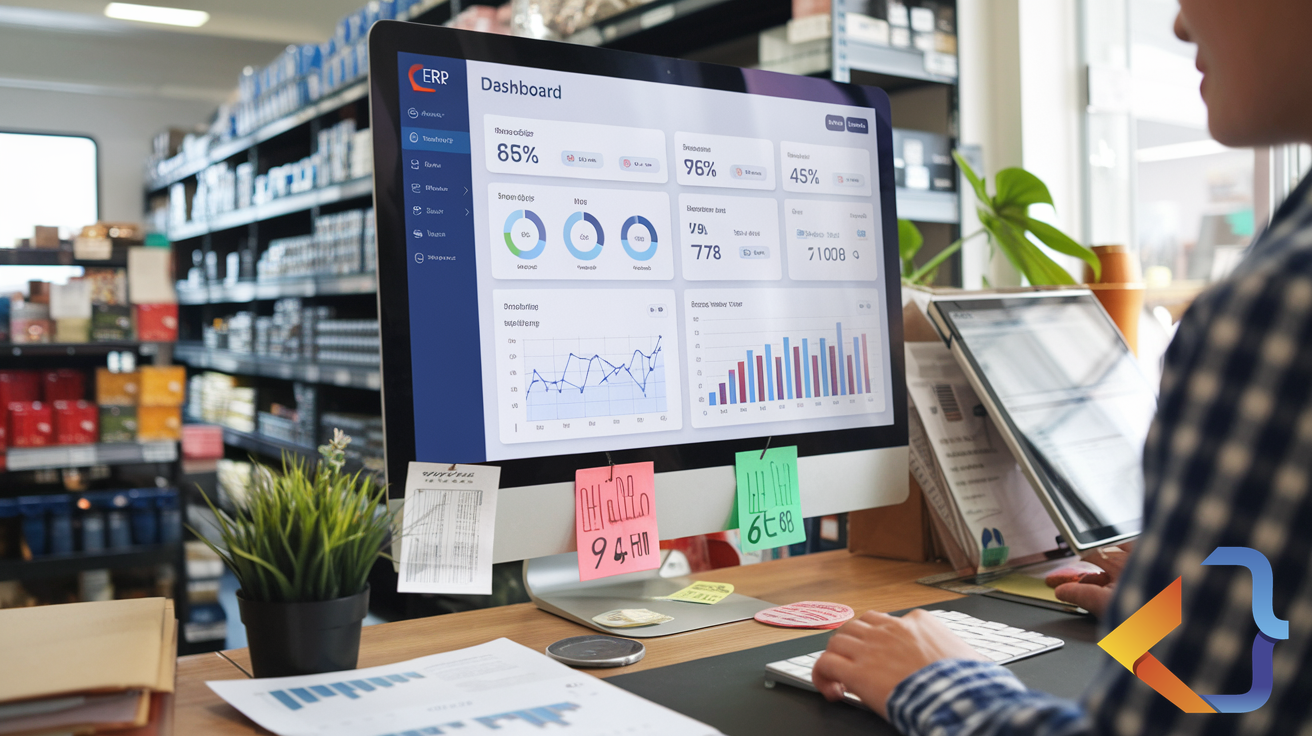
An all-in-one business management software solution — which is what ERP essentially is — puts your stock, orders, finances, customer records, and reporting all inside a single system. They all update in real time. You enter something once, and the rest of the system knows about it automatically.
Think of it like upgrading from a collection of notebooks to a single, intelligent filing cabinet that organises itself. That is the idea behind ERP.
According to Wikipedia’s overview of Enterprise Resource Planning, ERP systems have existed since the 1990s — but they were originally built for large manufacturers with enormous budgets. The good news is that cloud-based versions (hosted on the internet, rather than on your own servers) have made affordable ERP systems a genuine option for smaller operators.
Signs Your Business Needs ERP — Be Honest With Yourself

How do you know whether you have outgrown your current setup? Here are the clearest signs your business needs ERP. If three or more of these ring true, it is worth a serious look.
You Are Copying the Same Information Into Multiple Places
If you are entering a customer’s details into your booking system, then again into your accounts, then again into a separate email list — that is a significant red flag. It wastes hours every month, and it introduces errors. An ERP system removes that duplication entirely.
Your Reports Feel Unreliable
Imagine you are a solicitor in Birmingham trying to understand which services are most profitable this quarter. But your financial data is in one place, your time-tracking is in another, and your client records are in a third. Pulling together an accurate picture takes most of a Friday afternoon. With an ERP, that report is a few clicks away — and it is accurate because all the data comes from the same source.
You Cannot See Your Numbers in Real Time
If you only find out how the month went when your accountant sends you a summary three weeks later, you are flying blind. An affordable ERP system gives you a live view of your finances, so you can make decisions based on what is happening now — not what happened last month.
You Are Relying Heavily on Spreadsheets
Spreadsheets are brilliant for simple tasks. But when your entire operation depends on them, one accidental deletion or a formula error can cause serious problems. The goal of moving to replace spreadsheets with ERP is not about being fancy — it is about being reliable. The UK government’s guidance on company records makes clear that accurate, up-to-date financial records are a legal requirement for limited companies. An ERP helps you meet that standard with far less effort.
Your Team Is Growing and Things Are Getting Complicated
When it is just you, or you and one other person, informal systems can work fine. But the moment you have a handful of staff all needing access to the same information, things get messy fast. An ERP sets clear processes and gives everyone the right information at the right time.
Is ERP for Small Business UK Actually Affordable Now?
This is where things have genuinely changed. A decade ago, implementing an ERP system could cost tens of thousands of pounds and take months of set-up. That put it firmly out of reach for most independent businesses.
In 2026, cloud-based ERP for small business UK options often start from as little as £30–£80 per user per month. Some providers offer entry-level plans aimed squarely at businesses with fewer than twenty staff. You do not need a dedicated IT department. You do not need to buy expensive hardware. You log in through your browser, much like you would with your email or your online banking.
It is worth noting that not every ERP will suit every business type. A beauty salon has very different needs to an e-commerce retailer or an accountancy practice. The key is finding a system that covers the modules — the individual sections — that matter most to you, rather than paying for features you will never use. Forbes Advisor’s guide to ERP software offers a useful comparison of some of the most widely used platforms if you want a starting point for research.
You might also find it helpful to read our guide on choosing between custom software and off-the-shelf solutions, which covers a similar decision-making process in plain English.
When ERP Is Probably Not the Right Move (Yet)

Honesty matters here. Not every small business is ready for an ERP system, and jumping in too early can create more confusion than it solves.
If your business is genuinely simple — say, a sole trader offering one service to a small, steady client base — then a dedicated accounting tool like Xero or QuickBooks, combined with a good calendar app, may be all you need. Paying for an all-in-one business management software solution when you only need two of its fifteen features is not efficient.
Similarly, if your processes are not yet documented — if everything lives in your head — then implementing an ERP before you have mapped out how your business actually runs can feel overwhelming. It is worth getting some basic processes written down first.
According to research cited by The Guardian’s Small Business Network, one of the most common reasons small business technology projects fail is choosing a solution that is more complex than the business genuinely needs at that stage. Start with the problem you are actually experiencing, not the solution that sounds most impressive.
A Real-World Example: The Hair Salon in Manchester
Imagine you run a mid-sized hair salon in Manchester with six stylists and a reception desk. Right now, appointments are in one system, product stock is tracked on a clipboard, payroll is handled by a separate payroll provider, and your accountant works from a mix of bank statements and rough notes you email over each month.
Every time you want to know whether a particular treatment is profitable, you have to piece it together from three different places. When a stylist leaves, nobody is entirely sure what their client list looked like. And at the end of each quarter, preparing information for your accountant takes a full day.
An affordable ERP system built for service businesses could tie all of that together. Appointments would feed directly into your revenue reporting. Stock levels would update as products are used. Payroll data would flow from the same system. Your accountant could log in and pull what they need without you sending a single spreadsheet. This is the kind of practical difference that do small businesses need ERP software UK conversations are really about — not technology for its own sake, but genuine time and money saved.
For more on how connected software can change the day-to-day running of a service business, take a look at our post on simple automation ideas for UK small business owners.
Do Small Businesses Need ERP Software UK? The Honest Verdict
The answer is: it depends — but probably sooner than you think. If you are at the stage where disconnected systems are costing you hours each week, where your reporting is unreliable, or where you are genuinely struggling to get a clear picture of your business, then exploring ERP for small business UK is a very sensible next step.
It is no longer an enterprise-only investment. Affordable ERP systems exist specifically for businesses your size. The question is not really whether you can afford to consider it — it is whether you can afford to keep patching things together with spreadsheets and workarounds as your business grows.
As BBC Business regularly highlights, UK small businesses that invest thoughtfully in the right digital infrastructure tend to outperform those that delay. That does not mean rushing into anything. It means making an informed decision at the right moment.
Next Steps: What You Can Do Today
Before you look at any software, spend fifteen minutes writing down the three biggest administrative frustrations in your business right now. Where are you losing time? Where do errors creep in? Where do you feel like you are operating blind?
That short list will tell you more about whether you need an all-in-one business management software solution than any product brochure. Once you have it, you have something concrete to discuss with a specialist — rather than trying to evaluate software in the abstract.
If you would like an honest, no-pressure conversation about whether do small businesses need ERP software UK applies to your particular situation, the team at VeCar Digital Programming is here to help. We work with independent UK businesses every day, and we will tell you straight if ERP is the right fit — or if something simpler would serve you better. Get in touch with us today and let’s have a proper conversation about what your business actually needs.
Frequently Asked Questions
What is ERP software and how does it differ from basic accounting tools?
ERP (Enterprise Resource Planning) software integrates multiple business functions—accounting, inventory, HR, and sales—into one system. Unlike standalone accounting tools such as QuickBooks or Xero, ERP eliminates data silos by connecting all departments. For small UK businesses, this means fewer spreadsheets, less manual data entry, and a single source of truth across your entire operation.
At what stage should a small UK business consider implementing ERP?
Consider ERP when your business reaches around 10–50 employees, manages multiple product lines, or struggles with disconnected systems causing errors and delays. Key triggers include rapid growth, expanding into new markets, difficulty tracking stock accurately, or spending excessive time reconciling data across separate tools. If admin is slowing growth, ERP is worth evaluating seriously.
Is ERP software affordable for small UK businesses with limited budgets?
Yes, increasingly so. Cloud-based ERP solutions like Sage 200, Odoo, and Microsoft Business Central offer scalable pricing, often starting from £50–£300 per month depending on modules and users. Unlike legacy systems requiring expensive on-premise infrastructure, modern cloud ERP reduces upfront costs significantly. Many vendors offer SME-specific packages, free trials, and flexible contracts suited to smaller UK businesses.
How long does ERP implementation typically take for a small business?
For small businesses, cloud ERP implementation typically takes four to twelve weeks, depending on complexity, data migration needs, and customisation requirements. Simpler deployments using out-of-the-box configurations can be faster. Choosing an experienced UK-based implementation partner and ensuring staff training is prioritised will significantly reduce disruption and help your team adopt the system confidently from day one.
What are the biggest risks of implementing ERP in a small UK business?
Common risks include underestimating implementation costs, poor data migration, insufficient staff training, and choosing an overly complex system. To mitigate these, clearly define your requirements before purchasing, involve key staff early, and select a vendor with proven SME experience. Avoid over-customising the system initially—start with core modules and expand as your confidence and business needs grow.