
Do Small Businesses Need ERP Software in the UK?
If you are juggling one spreadsheet for stock, another for invoices, a separate payroll tool, and a notebook for supplier contacts — you are not alone. Thousands of UK sole traders and small teams ask themselves the same question every year: is there a better way? That question often leads to the phrase do small businesses need ERP software UK typed into a search bar at half past ten on a Tuesday night. This guide is for you.
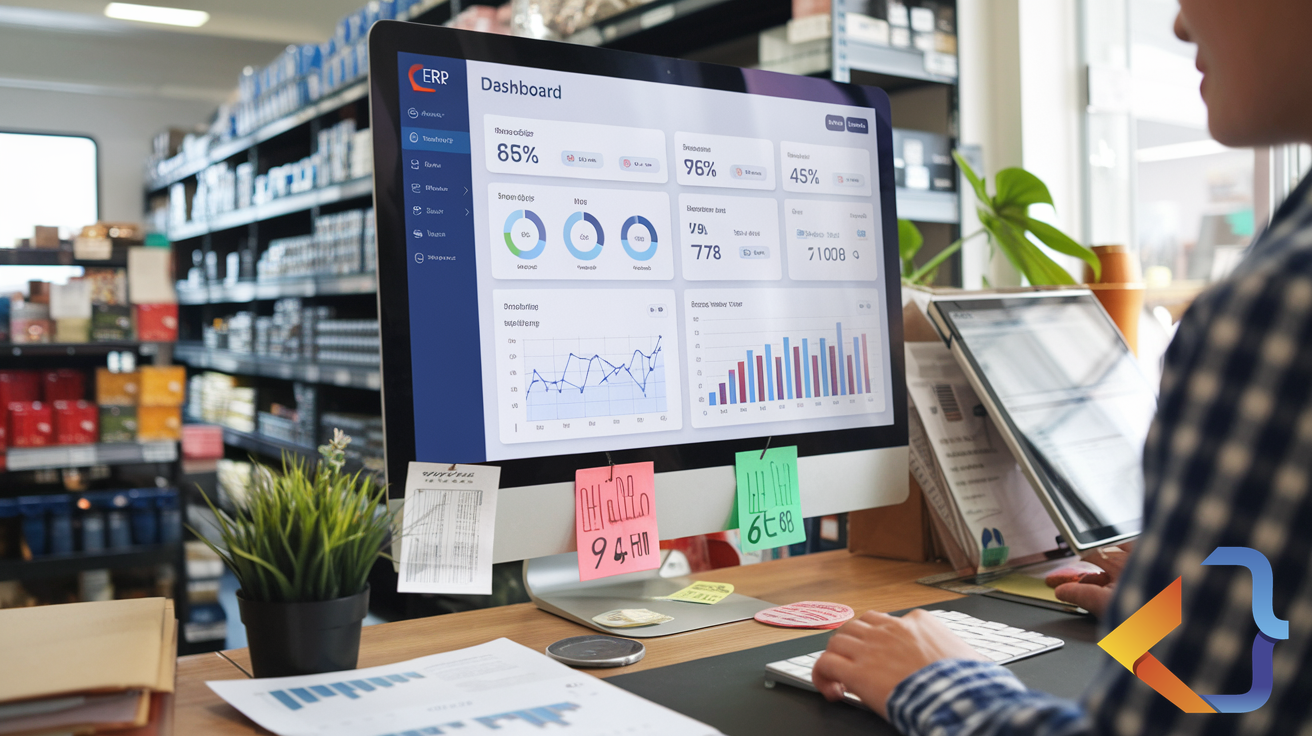
Do small businesses need ERP software in the UK? In short: not always, but often yes. ERP for small business explained simply means one joined-up system that handles your stock, invoicing, payroll, and reporting in one place. If disconnected apps are costing you hours each week, an affordable ERP system UK could pay for itself quickly.
What Actually Is ERP? (In Plain English)
ERP stands for Enterprise Resource Planning. Ignore the corporate-sounding name — the idea behind it is beautifully simple. Instead of having five different programmes that never talk to each other, ERP is one central system where all your key business information lives together.
Think of it like this: your invoicing updates your accounts automatically. Your accounts feed into your payroll. Your stock levels adjust the moment a sale goes through. No copy-pasting. No chasing figures across three browser tabs. Everything joined up, in one place.
Historically, ERP was only affordable for large corporations. That changed dramatically over the last decade. Enterprise resource planning systems are now available in cloud-based, subscription versions that suit teams of two as well as teams of two hundred. If you have been wondering whether ERP for small business explained applies to your situation, the honest answer is: it probably does.
The key thing to understand is that ERP is not about flashy technology for its own sake. It is about reducing the mental load of running a business. Fewer manual entries means fewer errors. Fewer errors means fewer headaches — and fewer awkward conversations with your accountant.
Why Disconnected Apps Are Quietly Draining Your Time
Here is a scenario many independent retailers will recognise. You run a trade supplies business with a small warehouse and a tight team. You use one tool for invoicing clients, a separate spreadsheet to track stock, a payroll provider your bookkeeper set up three years ago, and a generic inbox where purchase orders land from suppliers. None of these systems speak to each other.
Every month, someone — probably you — spends hours reconciling figures between systems. You check whether what was invoiced matches what left the warehouse. You chase down a missing supplier invoice. You realise a product sold out three days ago but the website still shows it as available. That lost time has a real cost, and in 2026 it is a cost that affordable ERP systems UK providers have made entirely avoidable.
According to the UK government’s Department for Science, Innovation and Technology, improving digital adoption among small and medium-sized businesses is a national priority — precisely because the productivity gains are substantial. The tools now exist. The question is whether you are using them.
The cost of not acting compounds quietly. An hour lost per day across a team of three is over 700 hours a year. At even a modest hourly rate, that is a significant sum. ERP vs separate software tools is not just a technical debate — it is a financial one.
ERP vs Separate Software Tools: Which Is Right for You?
This is the most important question, and the honest answer depends on where you are right now. Separate specialist tools — a dedicated invoicing app, a standalone payroll service, a bespoke stock tracker — can be perfectly fine when your operation is small and your processes are simple. There is no need to overengineer things.
But there is a tipping point. When you find yourself manually transferring data between systems regularly, when errors keep creeping in, when you cannot get a clear financial picture without spending an afternoon pulling reports — that is when ERP vs separate software tools stops being a theoretical question and becomes an urgent practical one.
Inventory and invoicing in one system is one of the most immediate benefits small businesses notice. When a sale is made, the stock level drops automatically. The invoice is generated. The revenue is recorded. No manual step in between. For an independent retailer or a salon group managing product retail alongside service appointments, this alone can save several hours a week.
It is also worth noting that some ERP platforms integrate with tools you already use — including accounting software popular with UK businesses. You do not necessarily have to rip everything out and start again. A good advisor will look at your current setup and find the most sensible path forward. You can read more about how to choose the right software for your small business on the VeCar blog.
A Real-World Example: A Salon Group in the Midlands
Imagine you own three hair and beauty salons across the Midlands. Each location has its own appointment system. Stock — colour, treatments, retail products — is tracked on a shared spreadsheet that someone updates manually at the end of each week. Payroll is handled by an external firm who needs a monthly report your manager compiles by hand.
Now imagine one joined-up system. Appointments feed directly into staff scheduling and payroll calculations. Product sales at the till automatically reduce stock levels across all three locations. You can see, from your phone, which salon is performing best this month — without waiting for end-of-month reports. That is what streamline operations small business actually looks like in practice. Not a buzzword. A genuine shift in how your day feels.
Cloud-based affordable ERP systems UK providers now offer pricing tiers designed specifically for businesses of this size. Many start from as little as £50 to £150 per month for small teams — a fraction of what the same functionality cost five years ago. Forbes Advisor’s breakdown of ERP software options gives a useful overview of the landscape if you want to explore what is available at different price points.
What to Look for in an Affordable ERP System in the UK
Not every ERP system is built with small businesses in mind. Some are designed for manufacturers with hundreds of staff and complex supply chains. If you are a sole trader or a team of under twenty, you need something scaled appropriately. Here is what to look for.
First, make sure inventory and invoicing in one system is genuinely included — not an expensive add-on. Second, check whether it integrates with HMRC-recognised accounting software, which matters for Making Tax Digital compliance. HMRC’s Making Tax Digital guidance explains the requirements clearly if you are unsure what applies to your VAT situation.
Third, think about support. An ERP system is only as good as the help you get when something is unclear. Look for UK-based support, clear onboarding, and ideally a provider or agency that will take the time to configure the system around your actual processes — not the other way around. You should also explore how digital transformation works for small businesses to understand the broader journey this fits into.
Finally, scalability matters. The right system for you today should be able to grow with you. If you add a new location, a new product line, or a new member of staff, your system should accommodate that without a complete rebuild.
Common Concerns — and Honest Answers
Many small business owners hesitate for understandable reasons. Change feels risky when things are at least functioning. Here are the most common concerns, answered plainly.
Is it too complicated to set up? It can be, if you try to do it alone or choose the wrong system. With the right guidance, migration is manageable — and the long-term gain far outweighs the short-term disruption.
Will my team actually use it? Modern ERP systems are designed to be intuitive. Most have browser and mobile interfaces that feel familiar. Training time is typically measured in days, not months.
What if I am too small? There is no minimum size requirement. Which? Business Software reviews regularly feature tools suited to sole traders and micro-businesses. If you are spending more than three hours a week moving data between systems, you are large enough to benefit.
Next Steps: What You Can Do Today
Start with an audit. Spend twenty minutes writing down every tool, spreadsheet, and manual process your business currently uses to manage stock, invoicing, payroll, and reporting. Count how many separate places your business data lives. That list is your starting point.
If you count more than three disconnected systems, or you find yourself unable to answer a basic question like “what was our profit last month?” without digging through multiple places — it is worth having a proper conversation about whether do small businesses need ERP software UK applies to your situation.
At VeCar Digital Programming, we help UK small business owners cut through the noise and find practical digital solutions that actually fit their operation. Whether you are just beginning to explore ERP for small business explained or you are ready to streamline operations for your small business with a joined-up system, we are happy to have an honest, no-pressure conversation. Get in touch with the VeCar team today and let us help you find the right path forward.
Frequently Asked Questions
What is ERP software and do small UK businesses actually need it?
ERP (Enterprise Resource Planning) software connects core business functions — finance, inventory, HR, and sales — into one system. Small UK businesses need it when disconnected spreadsheets and apps cause errors, delays, or lost data. If you’re spending more time managing tools than running your business, ERP could streamline operations significantly and support sustainable growth.
How much does ERP software typically cost for a small UK business?
Costs vary widely. Cloud-based ERP solutions like Sage, Xero, or Microsoft Business Central range from £50 to £500+ per month depending on users and features. Implementation and training add upfront costs. Many vendors offer SME-friendly pricing tiers, so small businesses should request tailored quotes rather than assuming enterprise pricing applies to them.
What are the signs my small business has outgrown spreadsheets and needs ERP?
Key warning signs include: duplicate data entry across multiple tools, frequent stock discrepancies, slow month-end reporting, difficulty tracking cash flow in real time, and staff spending excessive time on manual admin. If these problems sound familiar, ERP software could eliminate inefficiencies and give you accurate, centralised business data immediately.
Which ERP systems are best suited for small businesses in the UK?
Popular UK-friendly options include Sage 200, Microsoft Dynamics 365 Business Central, Xero (accounting-focused), Odoo, and NetSuite. The right choice depends on your industry, team size, and budget. Look for HMRC-compatible software that supports Making Tax Digital (MTD) compliance, as this is a legal requirement for UK VAT-registered businesses.
How long does it take to implement ERP software in a small business?
Implementation timelines typically range from four weeks to six months, depending on system complexity, data migration needs, and staff training requirements. Cloud-based ERP solutions generally deploy faster than on-premise alternatives. Proper planning, a clear project scope, and vendor support significantly reduce disruption and help small businesses go live on schedule.